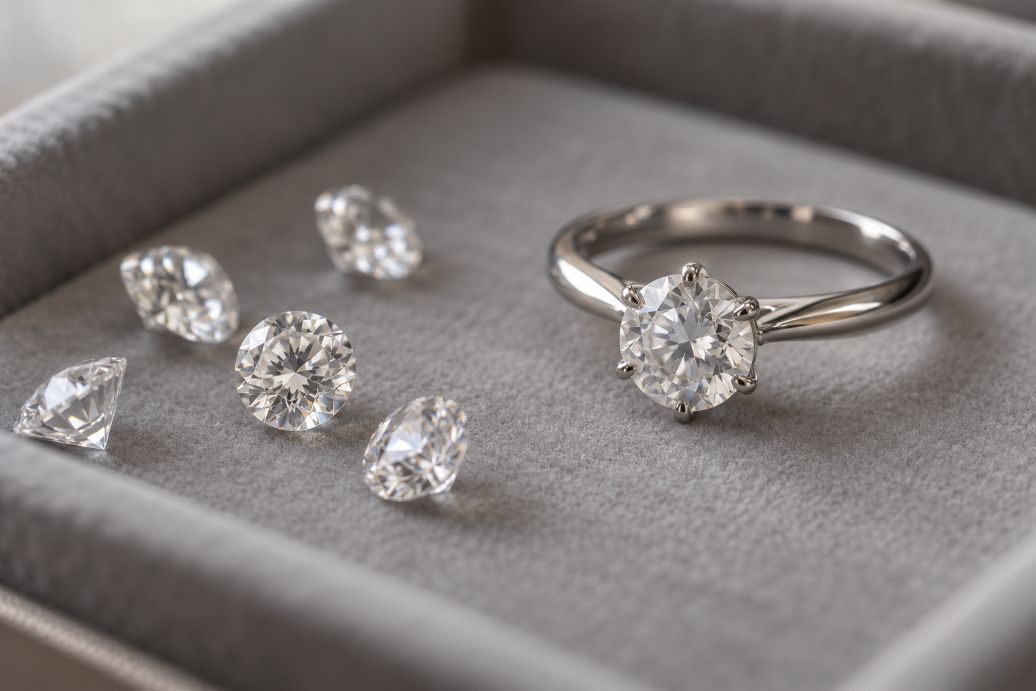
Rapaport’s October 6 report showed that smaller, higher-quality natural diamonds led September’s price recovery. Its index rose 3.2% for 0.30-carat stones and 2.5% for 0.50-carat stones. The 1-carat category gained just 0.3%, showing that the rebound remained uneven.
For holiday shoppers, the challenge is interpreting those figures without letting market headlines dictate a budget. Rapaport tracks trade asking prices for selected round diamonds, rather than completed consumer purchases. Five practical checks can help translate that market news into a better buying decision.
1. Could a slightly smaller stone fit better?
Stone weight deserves attention before choosing a setting. The Gemological Institute of America (GIA) explains that prices per carat generally rise at popular thresholds, including 1.00 and 1.50 carats. A 0.95-carat diamond can look almost identical to a 1-carat stone while costing less per carat.
Compare nearby weights rather than fixing your budget around a round number. Decide how much visible size matters to the recipient, then ask to see alternatives within the same spending limit.
2. Higher grades need closer examination
GIA identifies color, clarity, cut and carat weight as the central quality factors. Small differences can substantially affect value, while cut influences brightness and sparkle.
Request exact grades and an independent report where applicable. GIA’s buying guidance recommends specific descriptions rather than broad quality ranges. Compare appearance as well as paperwork, and avoid paying for a higher grade simply because it sounds more impressive.
3. Availability can outweigh the headline trend
Rapaport attributed September’s rebound to reduced supply amplifying rising demand. Round diamonds benefited from sharper production reductions, while smaller, lower-quality stones remained under pressure from laboratory-grown competition.
This means “small diamonds” are not one uniform market. Ask whether a quoted stone is available, when it can be delivered and how long the price remains valid. Allow time to compare alternatives before committing to a holiday deadline.
4. What does the retail quote include?
Rapaport’s index covers selected loose diamonds offered within the trade. It does not measure the complete price of a finished ring, necklace or pair of earrings.
For budgeting, request an itemized quote separating the stone, setting, taxes and additional services. Compare equivalent specifications across sellers before judging a discount. GIA also recommends checking return policies and insured shipping when buying online. A lower headline price deserves careful examination if purchase terms differ.
5. Resale expectations should stay realistic
GIA distinguishes a grading report from an appraisal. The report describes quality; an appraisal estimates monetary worth. Neither guarantees what a buyer will offer later.
Avoid treating September’s recovery as a promise of investment returns. Choose an amount you can comfortably spend without relying on future resale proceeds.
Will holiday purchases confirm the recovery?
The next test is whether stronger trade prices are supported by sustained consumer buying. Watch retailer sales, discounting and replenishment after holiday purchases. Broader demand across sizes and qualities would strengthen the recovery story. Continued weakness outside selected categories would suggest a narrower rebound, leaving careful comparison essential for holiday jewelry budgets.